
Ladder Polymer Science
Since Staudinger proposed the “macromolecular hypothesis” in 1920, polymer science has continued to develop over the past 100 years as a crucial field of research, deeply involved in a wide range of fields, from cutting-edge materials science to life sciences. Polymers are generally recognized as giant molecules composed of small units called “monomers” that are covalently linked together in a single chain-like fashion, and can be imagined as a beads necklace at the molecular level. Then,
“What would happen if we added another bond between the monomer units?”
Such polymers are called ladder polymers. In conventional (single-stranded) polymers, only a single bond connects the monomer units, allowing free rotation around the bond axis. As a result, the overall macromolecular structure tends to be disordered. In contrast, in ladder polymers, two or more chemical bonds connect between adjacent monomer units, severely constraining the conformation along the main chain. Hence, the structural order is dramatically increased. This “addition of just one more chemical bond” restricts conformational freedom, potentially leading to critical differences between single-stranded polymers and ladder polymers.
This simple design concept of adding a second bond to polymers has the potential to advance polymer science from both a structural and functional perspective. However, the synthesis of ladder polymers remains challenging. This research project aims to achieve: (1) innovation in the synthesis of ladder polymers, (2) dramatic expansion of the structural diversity, and (3) elucidation of physical properties and development of advanced functionalities, pioneering the future of “ladder polymer science”.
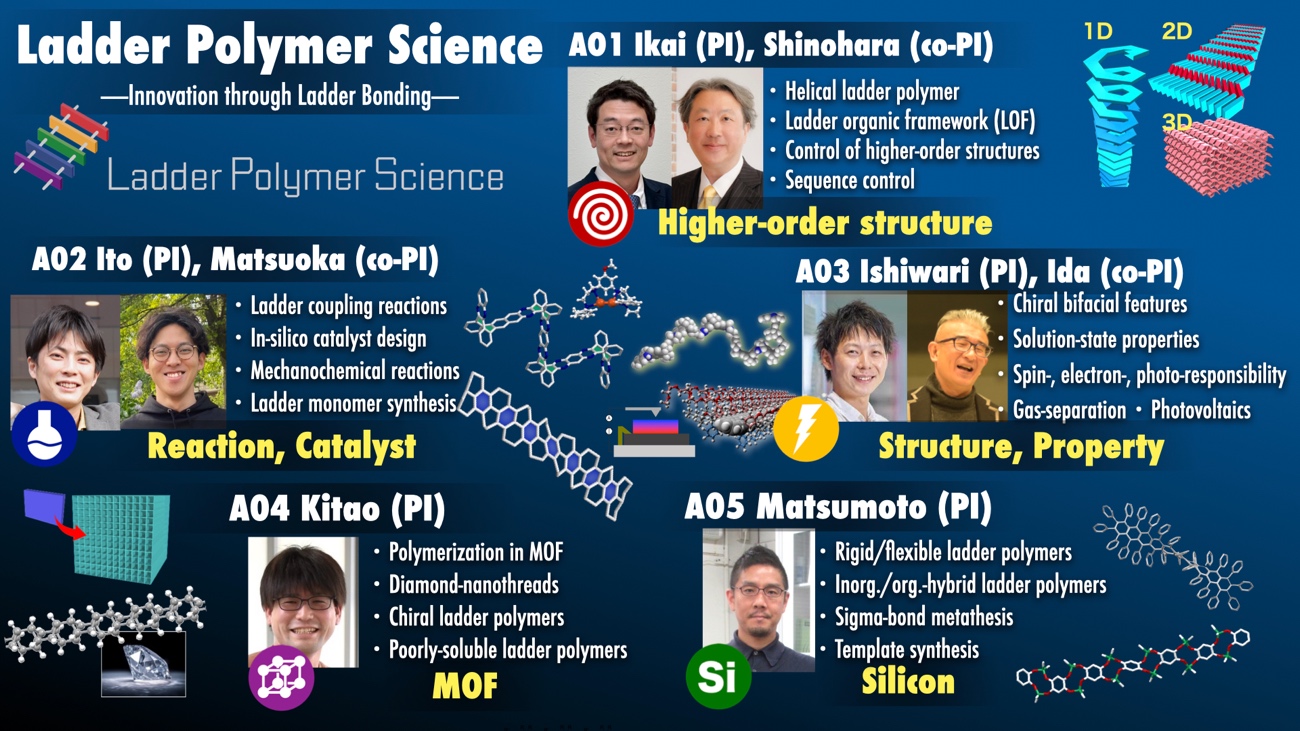
Research Projects
A01 Group: Ikai (PL, PI), Shinohara (Co-PI)

The goal of this study is to develop a precise synthetic method for creating a series of ladder polymers with well-defined secondary structures, such as helices and zigzags, by integrating computational science with our original “defect-free ladderization method,” which allows the construction of highly ordered ladder frameworks at the molecular level. Furthermore, we propose a new class of materials termed Ladder polymer-based Organic Frameworks (LOFs), consisting of ladder polymers with secondary structures arranged in various dimensions. We seek to contribute to the development of a new frontier in materials science by taking advantage of the unique electronic, optical, and magnetic properties arising from the distinct ladder structures and their assemblies.
Ikai: https://ladpoly.chembio.nagoya-u.ac.jp/
Shinohara: https://www.jaist.ac.jp/ms/labs/shinohara/index.html
A02 Group: Ito (PI), Matsuoka (Co-PI)

The goal of this research group is to advance ladder polymer science by developing new synthetic methodologies for constructing ladder skeletons, which is the biggest bottleneck in this field. To achieve this, we will develop various new ladderization reactions, new monomers suitable for ladderization, and new catalytic systems designed by in-silico methods. Using not only the newly developed solution reactions, but also mechanochemical reactions, we will try to create novel (non-)conjugated ladder frameworks, including non-hexagonal ladder molecules, which have been difficult to synthesize by conventional methods. Ultimately, we will demonstrate the significance of constructing ladder frameworks over conventional oligomers/polymers.
Matsuoka: https://researchmap.jp/wataru_matsuoka
A03 Group: Ishiwari (PI), Ida (Co-PI)

Ladder polymers can be regarded as a treasure trove of functions, offering superior properties such as enhanced charge transport and intrinsic microporosity compared to conventional polymers. In this study, we aim to develop ladder polymers with unique chemical structures based on our group’s original “bifacial molecular motif,” with the goal of further improving their physical properties and exploring new functionalities.
A04 Group: Kitao (PI)

Ladder polymers are synthesized through multi-point coupling reactions, which often lead to undesired cross-linking and branching when performed in solution or bulk, making structural control a significant challenge. To overcome this issue, our group has developed a template synthesis method utilizing metal–organic frameworks (MOFs) as reaction fields. In this study, we aim to further amplify and refine the unique features of this approach by exploring the synthesis of novel ladder polymers, such as chiral graphene nanoribbons and diamond nanothreads, thereby unveiling new possibilities for the MOF-template method.
A05 Group: Matsumoto (PI)

This research explores two approaches to the precise synthesis of ladder polymers, based on the unique properties of Si–O bonds—namely their thermodynamic stability, flexibility, and potential for sequence control. The first approach focuses on developing a defect-free ladder polymerization via Si–O sigma-bond metathesis. The second explores the use of sequence-defined oligosiloxane templates to guide the controlled assembly of ladder architectures. These approaches aim to provide multiple synthetic strategies for the precise construction of ladder architectures and to generate structurally diverse, novel silicon-containing ladder polymers.
Matsumoto : https://unit.aist.go.jp/cpt/en/groups/008_cpt-orxn.html